Dachshund vs Badger: The Ultimate Showdown

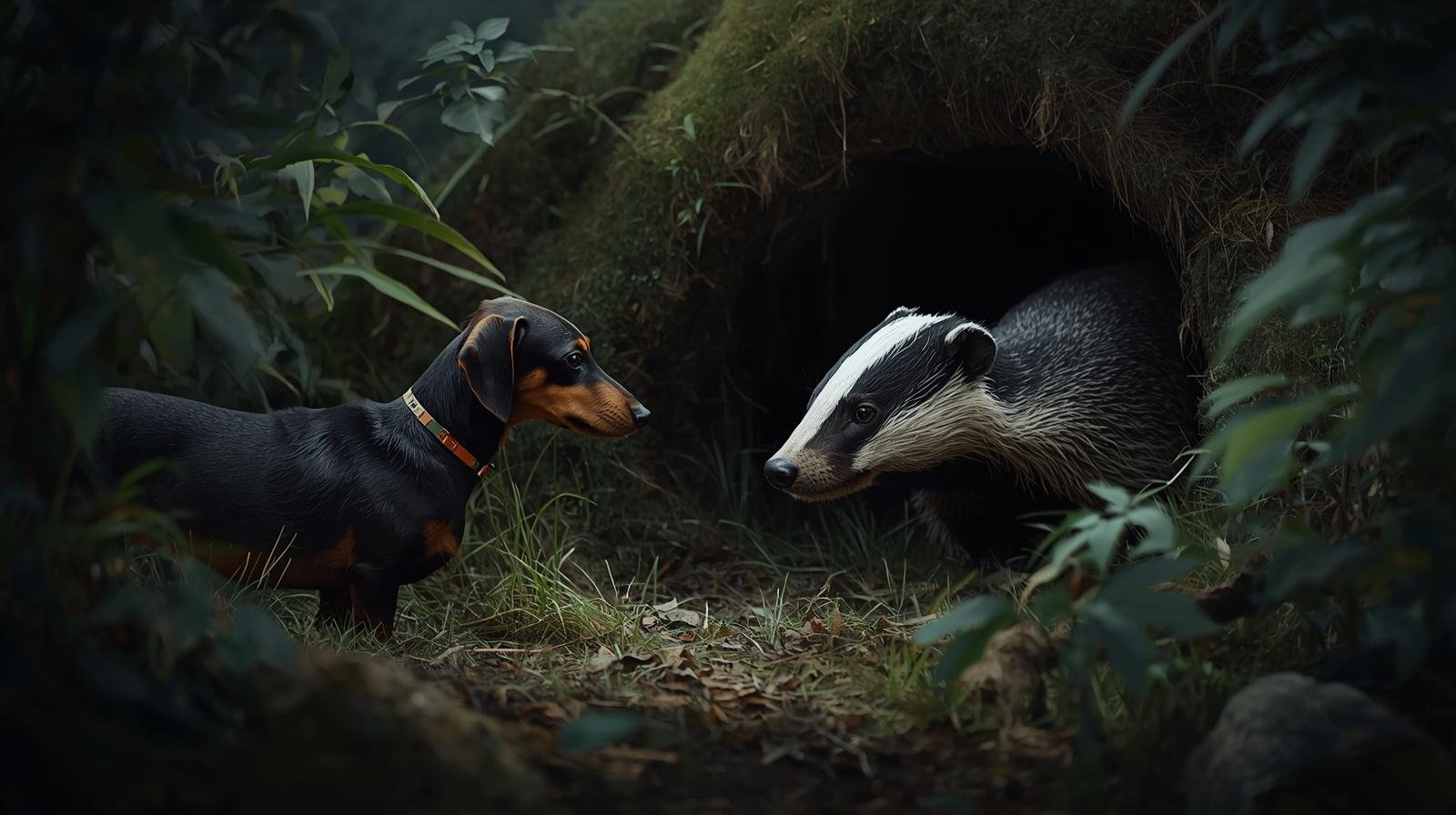
The Little Dog With a Big Enemy
There’s a story I love to tell at dinner tables, the one that makes people stare blankly for a second and then burst out laughing: the world’s most beloved sausage dog was literally engineered to go underground and fight one of nature’s toughest little tanks.
That’s the dachshund vs badger story and it’s far more epic than most dog lovers realize.
When you scroll past a dachshund in a hot-dog Halloween costume, it’s hard to believe this is a breed built for battle. But spend five minutes reading about the dachshund vs badger rivalry and you’ll never look at a wiener dog the same way again. This ancient predator-prey relationship shaped an entire breed’s anatomy, psychology, and legacy and it’s still driving dachshund popularity in 2025 and beyond.
Let’s dig in. Literally.
What “Dachshund” Actually Means (And Why It Matters)
The name gives it away immediately. “Dachshund” comes from the German words “Dachs,” meaning badger, and “Hund,” meaning dog so the breed’s very name is defined by its opponent. This isn’t a coincidence. Every physical trait, every behavioral quirk, every stubborn streak this dog has was deliberately cultivated for one purpose: winning the dachshund vs badger confrontation underground.
The dachshund’s story begins in the dense forests of 17th-century Germany, where hunters needed a dog with very specific traits. Their elongated bodies and short legs a result of deliberate breeding were perfect for burrowing into tight spaces, specifically to hunt badgers.
This isn’t just history. It’s the reason your dachshund digs up your garden, barks at nothing, and refuses to back down from your neighbor’s Labrador three times its size.
Dachshund vs Badger: Understanding Both Opponents
The Dachshund: Small Dog, Warrior Spirit
The original German dachshunds were bigger than the modern full-sized dogs, weighing 31 to 40 pounds. In addition to being used for hunting badgers, they were also used for hunting rabbits, foxes, and were even used for tracking wounded deer. It wasn’t unheard of for packs of dachshunds to be used for hunting wild boar.
Today’s dachshunds come in two sizes standard and miniature and three coat types: smooth, wirehaired, and longhaired. But regardless of size or coat, the hunting instinct runs deep. When a dachshund is on the hunt, it immediately goes into digging mode. It finds a burrow and uses its large, powerful front paws to expand the opening, then pushes its long body down the hole, completely blocking any escape route.
That’s not aggression for aggression’s sake. That’s centuries of genetic programming at work.
The Badger: Nature’s Underground Tank
Now meet the other side of the dachshund vs badger equation and do not underestimate it.
Badgers are built like furry little tanks. Their low center of gravity, powerful muscles, and tenacity make them impressive adversaries. They can dig through incredibly tough terrain, overpower prey, and stand their ground against much larger animals.
Long, curved front claws on webbed front feet and shovel-like back claws help badgers dig into burrows, and strong jaws and sharp teeth serve to rip prey apart. Like all badgers, this species is fierce and built for defense, with thick, loose fur and muscular necks that make them harder to catch.
The numbers are startling. The bite force quotient of badgers is greater than that of black American bears badgers have a BFQ of 108, while the black American bear has just 64, and the brown bear just 78.
So yes the dachshund vs badger matchup was never one-sided. This was a genuine battle of wills, bodies, and instinct.
A Side-by-Side Comparison: Dachshund vs Badger
Here’s a quick breakdown of how these two ancient rivals stack up physically and behaviorally:
| Trait | Dachshund | Badger |
|---|---|---|
| Average Weight | 16–32 lbs (standard) | 20–30 lbs (European) |
| Primary Weapon | Tenacity, bark, bite | Claws, powerful jaw, thick skin |
| Bite Force Quotient | Moderate | 108 BFQ (stronger than a bear) |
| Burrowing Ability | Yes bred for it | Expert natural tunneler |
| Defense Mechanism | Speed, agility, loud bark | Loose thick skin, odor glands, jaw lock |
| Temperament | Fearless, stubborn, loyal | Solitary, territorial, fierce |
| Modern Role | Companion, show, earthdog trials | Wild protected in many countries |
What this table makes clear is that the dachshund vs badger pairing was never a mismatch it was a rivalry of near-equals, with the dog leveraging persistence and the badger leveraging raw physical armor.
How Germans Engineered a Dog to Beat the Badger
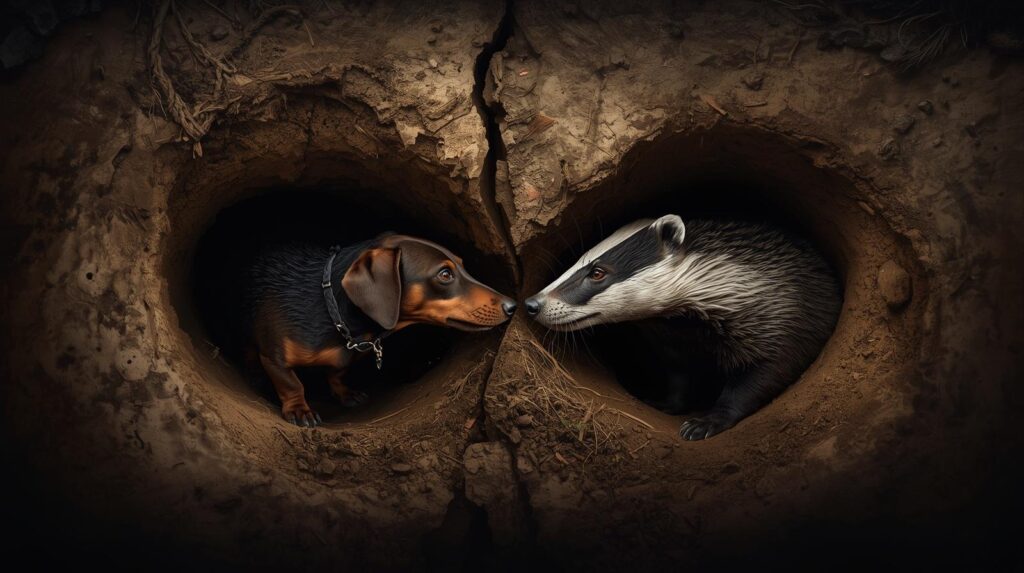
The dachshund vs badger dynamic didn’t happen by accident. It was the result of roughly two centuries of selective breeding. Europeans had been using dogs to hunt badgers since the Middle Ages, but it wasn’t until the late 1600s that the dachshund breed began to take form. The Germans knew they had to develop a dog with short legs and an elongated body to easily fit into badger burrows.
By the 18th century, German foresters and hunters began to breed their type consistently, paving the way for the breed we know today.
Every structural detail served a purpose in the dachshund vs badger hunt:
- Low, elongated body — to navigate tight underground tunnels
- Oversized paddle paws — to dig efficiently and rapidly
- Floppy ears — deliberately bred in to keep grass seeds, dirt, and other matter from entering the ear canal during underground pursuits
- Long, stiff tail — so the hunter above ground could grab and pull the dog out after the confrontation
- Loud, resonant bark — to locate the dog underground by sound
The entire breed is a biological toolkit designed around one adversary. That’s remarkable engineering and it speaks to just how formidable badgers were considered to be.
The Dachshund’s Fearless Reputation Explained
People who own dachshunds often say the same thing: “My dog doesn’t know how small it is.” That’s the dachshund vs badger legacy playing out in your living room.
The same swagger that makes the dachshund such a masterful badger hunter doesn’t make for mindless obedience. These dogs are opinionated, courageous, and occasionally infuriating all traits that were useful when your job was to crawl into a dark tunnel and confront an animal with a bite force stronger than a bear.
I’ve had the pleasure of spending time with wirehaired dachshunds specifically, and the intensity in their eyes during play is something else entirely. You can see the hunter in there. It’s not aggression it’s focus. The dachshund vs badger history produced a dog that simply doesn’t accept defeat as an option.
According to the American Kennel Club, dachshunds are described as “curious, friendly, and spunky” but any owner knows there’s something fiercer lurking beneath those big brown eyes.
Modern Dachshunds: From Badger Hunters to Top-5 Most Popular
Here’s where the story gets even more interesting. The dachshund vs badger history has done nothing to hurt this breed’s appeal quite the opposite.
In 2025, the dachshund cracked the top five most popular dog breeds in the U.S. according to the American Kennel Club’s annual registration numbers, replacing the Poodle which had previously held a top-five spot. This marked the first time the dachshund secured a top-five position, with the French Bulldog maintaining its hold as the most popular breed for the fourth year in a row.
That’s a breed with roots in underground combat now sitting in the top five most beloved family companions in America. The contrast is almost poetic.
Modern dachshunds are mostly companion animals or participate in regulated earthdog trials that simulate hunting without harming quarry. These trials let dachshunds express their working behaviors safely, keeping their dachshund vs badger instincts alive in a controlled, humane environment.
For a comprehensive breakdown of breed care, temperament, and health considerations, explore our Dachshund Guides everything a new or experienced dachshund owner needs in one place.
Why the Badger Was Such a Formidable Opponent
It’s worth pausing on just how extraordinary the badger is as an animal because understanding the badger is the only way to truly appreciate what dachshunds were up against.
Badgers have powerful 1.5-inch-long claws and teeth that are strong enough to crack a tortoise shell, making these small mammals a formidable opponent. Underneath their fur is a layer of loose, thick skin around the muscular neck, which protects the animal during fights and allows it to wriggle around and defend itself even when in the grasp of a predator.
The jaw and bite force of a honey badger are among the strongest of any animal so strong that the jaw can almost never be dislocated. If a badger bites into something, there is not much that can be done to force it to let go.
The Guinness Book of World Records has even recognized the honey badger as the world’s most fearless creature. In the dachshund vs badger equation, the badger was never the underdog it was the fortress the dachshund had to storm.
The Dachshund vs Badger Legacy in Popular Culture
The dachshund vs badger rivalry is more than zoological history it’s woven into folklore, literature, and modern dog culture. German hunters celebrated the dachshund’s courage as a national characteristic. In Britain, badger-baiting became a controversial practice that eventually led to legal protections for badgers in many countries.
Today, the legacy lives on in:
- Earthdog trials — AKC-sanctioned events where dachshunds and terriers navigate underground tunnels to find simulated quarry
- Breed temperament standards — courage, tenacity, and independence are official traits
- Internet culture — the “fearless dachshund” meme format is essentially the dachshund vs badger dynamic retold in digital form
The dachshund didn’t just survive its historical rivalry with the badger it was defined by it.
What This History Tells Us About Owning a Dachshund Today
Understanding the dachshund vs badger backstory makes you a better owner. When your dachshund:
- Digs holes in the yard — it’s practicing centuries-old burrow excavation
- Barks loudly at strangers — it’s doing its underground “locator bark”
- Refuses to back down from bigger dogs — it’s remembering that its original opponent had a BFQ of 108
- Ignores commands when on a scent — independent hunting decisions were necessary underground where no human could help
None of these behaviors are flaws. They’re features. Bred-in, historically validated features from the dachshund vs badger era that simply need to be understood and channeled appropriately.
Frequently Asked Questions: Dachshund vs Badger
Q1: Did dachshunds actually fight badgers in the wild?
Yes historically, dachshunds were bred specifically to enter badger burrows and either flush the badger out or confront it underground. The dachshund vs badger encounter was a real, intentional hunting strategy used by German foresters from at least the 17th century onward.
Q2: Who would win in a dachshund vs badger confrontation today?
In the wild, a badger’s superior armor, bite force, and defensive adaptations give it a significant advantage. Historically, trained hunting dachshunds — especially wirehaired varieties could still challenge them, but outcomes were never guaranteed.
Q3: Are dachshunds still used to hunt badgers?
In most countries, no. Badger hunting is restricted or banned in many regions. Today, dachshunds express their instincts through earthdog trials and controlled training activities instead.
Q4: Why do dachshunds have such a big personality for a small dog?
The dachshund vs badger history explains a lot. A dog bred to enter underground burrows and face dangerous prey had to be bold, independent, and persistent. Those traits still define the breed today.
Q5: Is the dachshund’s stubbornness really just a hunting instinct?
Largely yes. In underground hunting situations, independent decision-making was essential. That same instinct today can appear as stubbornness or selective listening.
