
Why Dachshunds Howl and How to Handle It

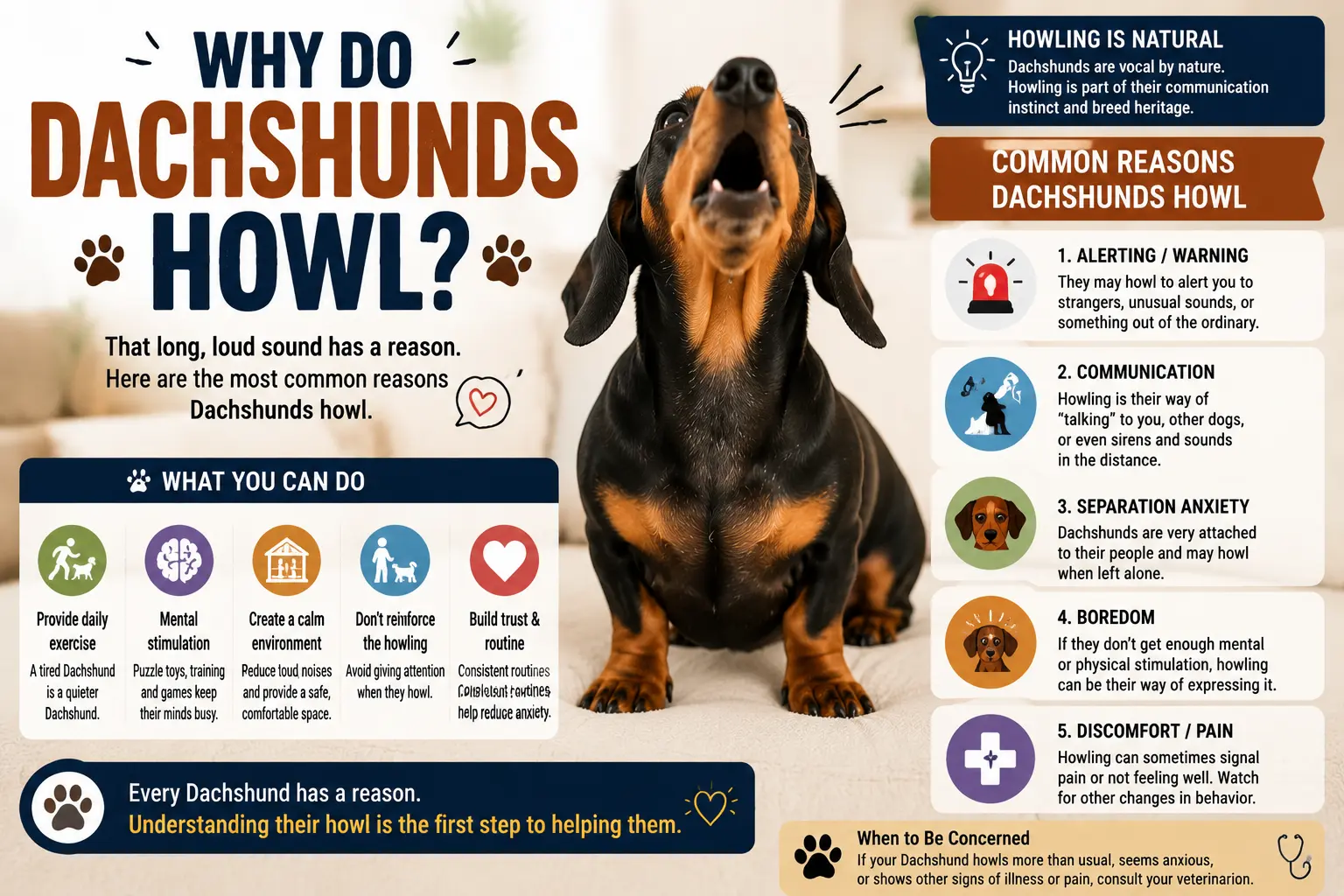
If you have ever been jolted awake at 2 AM by a long, dramatic “awoooo” echoing through your house, you already know the answer to this question firsthand. Why do dachshunds howl? It is one of the most searched questions among dachshund owners, and for good reason. These little sausage dogs carry a surprisingly big voice, and their howling can range from adorable to absolutely maddening depending on the hour.
I remember the first time my dachshund, Bruno, let out a full-throated howl at a passing ambulance. I was equal parts impressed and baffled. He looked so serious, so committed, like he had an important message to deliver. That moment sent me down a rabbit hole of research, and what I discovered completely changed how I understood him.
So, why do dachshunds howl? The short answer is instinct, emotion, and communication rolled into one very long, very loud sound. The longer answer is what this guide is all about.
The Ancient Hunting Roots Behind the Howl
To truly understand why do dachshunds howl, you have to travel back several centuries to rural Germany. The word “dachshund” literally translates to “badger dog” in German. These compact yet fearless dogs were purpose-bred to chase burrowing prey, including badgers, foxes, and rabbits, deep into underground tunnels.
Howling was not just a quirk back then. It was a critical job skill.
When a dachshund located prey underground, it would howl to signal its human hunting partners above ground. The howl carried through the earth, across fields, and over distances that barking simply could not reach. According to Purina, dachshunds were originally bred as hunting dogs, and howling is how they communicated scents and discoveries to their handlers.
That ancestral wiring does not disappear just because your dachshund now lives in a cozy apartment and gets kibble twice a day. Why do dachshunds howl when they hear a siren? Because somewhere deep in their DNA, that high-pitched sound triggers the same ancient instinct that once made them invaluable hunters.
Top Reasons Why Dachshunds Howl
Understanding why do dachshunds howl starts with identifying the trigger. Here are the most common causes backed by behavioral research and real owner experience.
They Are Reacting to Environmental Sounds
High-pitched sounds are one of the biggest howl triggers for dachshunds. Sirens, alarms, certain musical instruments, and even specific TV frequencies can set them off. Dachshunds may interpret these sounds as another dog or animal communicating with them from a distance, prompting them to howl back in response.
This is pure ancestral communication at work. Why do dachshunds howl at sirens specifically? Because the frequency closely mimics the pitch range of canine vocalization. Their brain hears it as a signal and responds accordingly.
Separation Anxiety Is a Major Factor
Dachshunds are notoriously bonded to their humans. They were bred to work closely alongside people, and that people-centric temperament means they genuinely struggle when left alone. According to research published in the Journal of Veterinary Behavior and cited by Paw Origins (2025), separation distress affects a significant portion of dogs, with clinical veterinary estimates ranging from 14 to 28% of the general dog population.
A DVM360 survey found that dog separation anxiety jumped over 700% in just two years following the pandemic, as dogs adjusted from constant human presence back to empty homes. Dachshunds, being among the most attachment-prone breeds, are especially vulnerable to this shift.
Why do dachshunds howl when you leave? Because they are genuinely distressed, not just being dramatic. That howl is a cry for connection.
Boredom and the Need for Mental Stimulation
A bored dachshund is a loud dachshund. These dogs are clever, curious, and bred to problem-solve. Without adequate mental and physical stimulation, they will find ways to entertain themselves, and howling is often at the top of that list.
Why do dachshunds howl in the middle of the afternoon for seemingly no reason? Check when they last went for a walk or had a puzzle feeder. Boredom howling tends to be rhythmic and repetitive, almost like they are singing to themselves.
Attention-Seeking Behavior
Dachshunds quickly learn that howling gets results. If howling once brought you running to check on them, they have filed that information away. Why do dachshunds howl even when nothing seems wrong? Sometimes, the answer is simple: it works, and they know it works.
This is operant conditioning at its most effective. The howl is a strategy.
Pain or Physical Discomfort
This is the howl that should never be ignored. When a dachshund howls in a way that seems sudden, intense, or out of character, it may be signaling that something is physically wrong. Dachshunds are genetically predisposed to intervertebral disc disease (IVDD) due to their elongated spine, and spinal pain can manifest as unexpected vocalization.
Why do dachshunds howl in their sleep? Occasional sleep howling is generally normal and tied to dream activity. But persistent or pained-sounding howls during waking hours warrant a vet visit without delay.
Excitement and Social Joy
Not every howl is a cry for help. Why do dachshunds howl when you come home? Because they are absolutely thrilled to see you. Excitement howling is usually paired with tail wagging, spinning, and general chaos. It is one of the more endearing reasons behind the question of why do dachshunds howl.
Howling Triggers at a Glance
| Trigger | Type of Howl | Recommended Response |
|---|---|---|
| Sirens or loud sounds | Short, reactive | Desensitization training |
| Being left alone | Prolonged, anxious | Separation anxiety protocol |
| Boredom | Repetitive, drawn-out | Exercise and enrichment |
| Attention-seeking | Persistent, calculated | Ignore and reward silence |
| Pain or illness | Sudden, intense, unusual | Vet visit immediately |
| Excitement | Brief, joyful | Acknowledge and enjoy |
How Dachshund Howling Compares to Other Vocal Hound Breeds
Why do dachshunds howl more than, say, a Golden Retriever? It comes down to breed classification. Dachshunds are scent hounds, a group of dogs historically bred to use their noses and their voices together during hunts. According to Pawlicy Advisor, other notable howlers in the hound group include Coonhounds, Bloodhounds, and Beagles, all sharing that same vocal heritage.
What makes dachshunds unique is the contrast between their tiny frame and their surprisingly resonant howl. Owners often describe it as disproportionately loud for such a small dog, which is exactly what centuries of selective breeding for underground hunting communication will produce.
For deeper breed-specific behavior guides, check out our Dachshund Guides for more insights into the quirks that make dachshunds one of a kind.
How to Manage and Reduce Excessive Howling
Now that we understand why do dachshunds howl, the next question is what you can actually do about it. Here are proven, humane strategies.
Desensitization Training for Sound Triggers
If your dachshund howls at specific sounds, gradual desensitization is your most effective tool. Play recordings of the triggering sound at a very low volume while keeping your dog calm and rewarding quiet behavior. Over several weeks, slowly increase the volume. The goal is to break the association between the sound and the howling response.
This process takes patience, but it is effective. Rushing it will undo your progress.
Address Separation Anxiety Directly
Why do dachshunds howl when alone? Because they have not been taught that being alone is safe. Start by practicing very short departures, even just a few minutes, and gradually build up. Never make arrivals and departures emotionally charged. Calm, matter-of-fact hellos and goodbyes reduce the drama your dachshund attaches to your comings and goings.
For severe cases, a certified veterinary behaviorist or professional trainer who specializes in separation anxiety can create a structured protocol tailored specifically to your dog.
Increase Physical Exercise and Mental Enrichment
A tired dachshund is a quieter dachshund. Why do dachshunds howl out of boredom? Because their intelligent minds are under-stimulated. Daily walks, scent games, puzzle feeders, and training sessions all drain energy that would otherwise be redirected into howling.
Scent work is especially powerful for dachshunds because it directly engages the instincts they were bred for. Hide treats around the house and let them find them. Ten minutes of nose work can be more exhausting than a thirty-minute walk.
Never Reward the Howl
Consistency is everything here. If you respond to howling with attention, even negative attention like shouting, you are reinforcing the behavior. When attention-seeking howling starts, turn away, leave the room, and return only when your dog is quiet. Then immediately reward the silence.
Why do dachshunds howl at the most inconvenient moments? Often because the reaction they get is the most attention-rich. Changing your response changes the behavior.
Rule Out Medical Causes First
Before attributing any sudden change in howling to a behavioral issue, get a clean bill of health from your veterinarian. Dachshunds and spinal problems go hand in hand, and IVDD pain is notoriously hard to detect without professional evaluation. When in doubt, rule out physical causes first.
Personal Reflection: Living With a Vocal Dachshund
Honestly? Once I understood why do dachshunds howl, my entire relationship with Bruno’s vocalizations shifted. What used to frustrate me became fascinating. He was not being defiant or difficult. He was communicating in the only language that thousands of years of breeding had given him.
I started treating his howls like data. Is this the excited howl when I grab the leash? The anxious howl when I leave the room? The demanding howl when his dinner is three minutes late? Each one tells me something different, and responding appropriately has made us a much better team.
The howl is not the problem. It is the signal. Your job as a dachshund owner is to learn the language.
Frequently Asked Questions
Why do Dachshunds howl at night?
Nighttime howling is most commonly caused by environmental sounds (such as sirens, wildlife, or other dogs), separation anxiety, or physical discomfort. If your Dachshund suddenly begins howling at night or seems uncomfortable, rule out pain or illness with your veterinarian before assuming it’s behavioral.
Is howling a sign that my Dachshund is unhappy?
Not necessarily. Howling is a natural form of communication for Dachshunds and doesn’t always indicate unhappiness. However, frequent, distressed, or excessive howling may signal anxiety, loneliness, boredom, or an underlying medical problem. Paying attention to when and why your dog howls can help identify the cause.
Can Dachshunds be trained to stop howling?
Yes. Most Dachshunds can learn to howl less through positive reinforcement, desensitization, regular exercise, mental enrichment, and addressing the underlying trigger. While you may not eliminate howling completely, you can usually reduce excessive vocalization with consistent training.
Why does my Dachshund howl when they hear music?
Some musical notes, especially long or high-pitched sounds, resemble frequencies dogs naturally use to communicate. Your Dachshund may instinctively respond by howling along, much like they would to a siren or another dog. This behavior is generally harmless and reflects their vocal nature.
When should I see a vet about my Dachshund’s howling?
Schedule a veterinary visit if your Dachshund suddenly begins howling more than usual, especially if it’s accompanied by stiffness, difficulty walking, reluctance to move, loss of appetite, or signs of pain. Because Dachshunds are prone to spinal problems such as IVDD, unexpected vocalization should never be ignored.
