
Dachshund Maltese Mix: The Liver Test Both Parent Breeds Point To

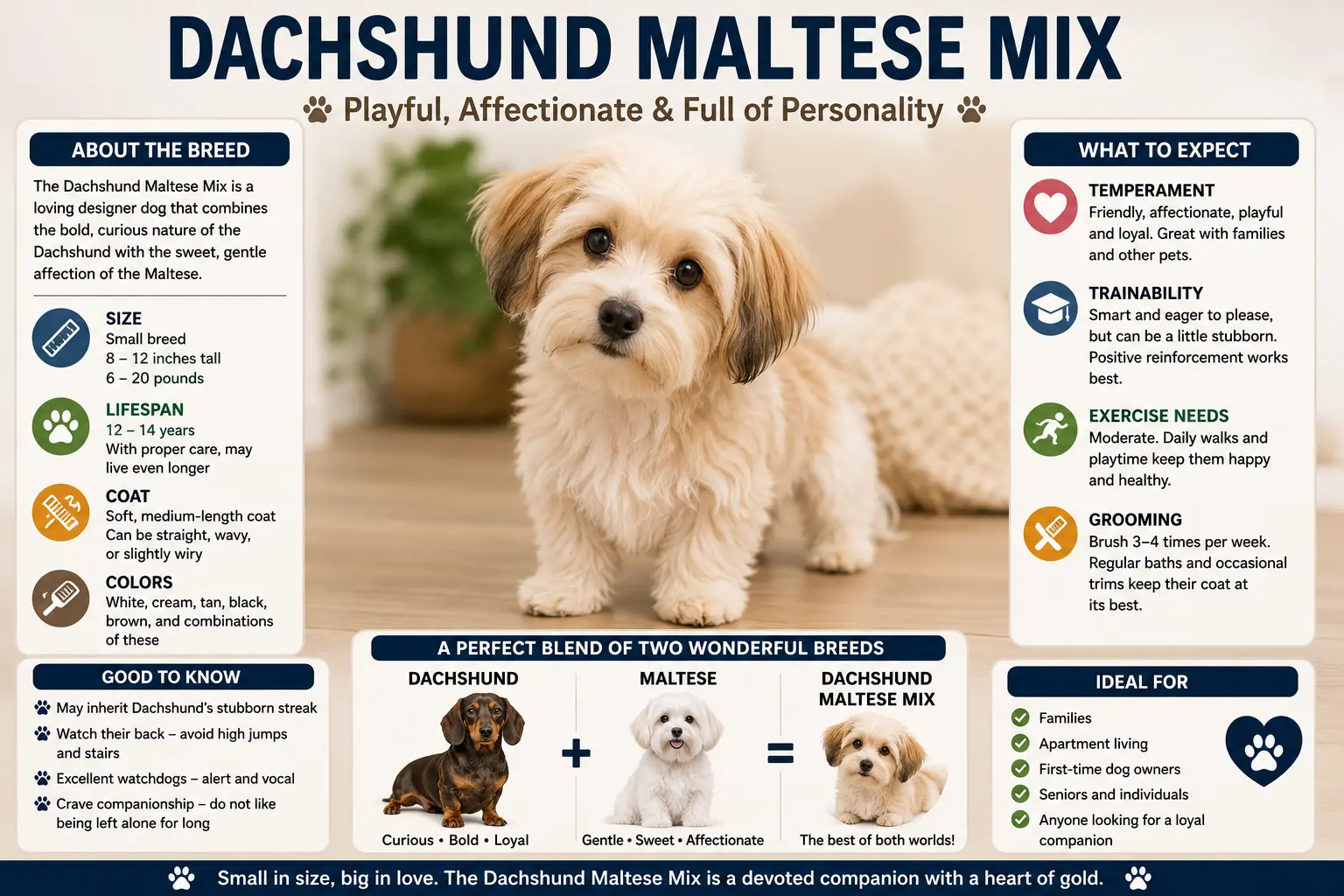
A dachshund Maltese mix, usually sold as a Mauxie, is a cross between a Maltese and a standard or miniature dachshund. It’s small, long-backed and often fluffy, and its size depends mostly on which dachshund you start with.
The health check worth asking about is one you’ll rarely see mentioned: a bile acids test. Both parent breeds have been reported as predisposed to congenital liver shunts, and that’s the part of this cross I’d want answered before anything else.
What a Mauxie is
It’s a first-cross between two breeds that look nothing alike, so the name tells you very little and no registry sets a standard for it. Here’s what the AKC lists for each parent, which is the only measured data that exists:
| Dachshund | Maltese | |
|---|---|---|
| Height | 8-9 in (standard), 5-6 in (miniature) | 7-9 in |
| Weight | 16-32 lb (standard), 11 lb and under (miniature) | under 7 lb |
| Life expectancy | 12-16 years | 12-15 years |
Nobody has weighed a sample of Mauxies, so I won’t give you a range for the cross. What the table does tell you is that the dachshund parent sets the ceiling. A miniature paired with a Maltese stays a very small dog, and a standard dachshund parent alone can weigh up to 32 pounds.
So ask which size the dachshund parent was.
It’s the single most useful question about how big your puppy will get, and a breeder who doesn’t know is telling you something.
The liver question both parents point to
If you haven’t met the term, a portosystemic shunt is a blood vessel that carries blood from the gut around the liver instead of through it, so the liver can’t filter it. Dogs are usually born with it, and small breeds tend to get the kind that sits outside the liver.
The largest breed study I found pulled 2,400 dogs diagnosed with congenital shunts from US veterinary teaching hospitals between 1980 and 2002. The proportions it reported are the reason this section exists:
| Group | Share diagnosed with a congenital shunt |
|---|---|
| Havanese | 3.2% |
| Yorkshire Terrier | 2.9% |
| Maltese | 1.6% |
| All dogs | 0.18% |
| Mixed-breed dogs | 0.05% |
So a Maltese was diagnosed at roughly nine times the rate for dogs overall. That’s the Maltese half of your puppy.
What about the dachshund half? It isn’t clean either. A Utrecht University review of 135 purebred dogs treated for shunts outside the liver between 2001 and 2010 lists the dachshund among the breeds described in the literature as predisposed. In that clinic’s own records, Maltese made up 15 of the cases and dachshunds 11.
You should know one honest caveat about that second source. It counts cases at one referral clinic, so it shows which breeds turn up, not how common shunts are in each. And the American College of Veterinary Surgeons names the Maltese in its list of affected breeds but doesn’t name the dachshund, so the evidence on the dachshund side is thinner.
Why “mixed breeds are healthier” doesn’t settle it
Can you borrow that 0.05% mixed-breed figure for your Mauxie? I wouldn’t. Mixed-breed dogs in that study are dogs of every background, and most of them have no particular reason to carry a shunt.
A Mauxie is a different thing: a cross between two breeds that both show up on the predisposed lists. That’s my reading rather than a measured result, because nobody has studied this cross. But mixing doesn’t dilute a risk both sides bring, and the Utrecht authors describe shunt inheritance in another small breed as complex and probably polygenic, which is not the kind of trait one cross cleanly removes.
What to ask for before you bring one home
The AKC recommends that Maltese puppies be bile-acid tested to rule out congenital liver problems, including shunts and microvascular dysplasia. A Mauxie has a Maltese parent, so the same test is the obvious thing to ask about.
The test is measured after an overnight fast and again two hours after a meal, according to the ACVS. If you’re told a result was high, don’t read it as a diagnosis. The ACVS notes that bile acids can rise with any liver disease, so a high number means more tests, not a confirmed shunt.
You should know the signs too. The ACVS lists small body stature, a slow recovery after anesthesia, and behavior changes that come and go and are often more noticeable after eating.
And after the first birthday? In the Utrecht data, one type of shunt was first diagnosed at about 12 months on average, but the milder type took about 32 months. A puppy who seems fine through the first year hasn’t necessarily cleared the question.
The back still comes from the dachshund side
The long back is the dachshund’s contribution, and it brings intervertebral disc disease with it. The Maltese isn’t long-backed, but don’t read that as the Maltese side being clear of the risk.
A 2019 UC Davis study of disc disease looked at the gene copy most closely tied to it, an extra FGF4 copy on chromosome 12 that acts in a dominant way, so one copy is enough to raise the risk. It found that copy at an allele frequency of 0.99 in dachshunds and 0.39 in Maltese. In other words, your Mauxie will almost certainly inherit it from the dachshund side, and some will get a second copy from the Maltese.
For purebred dachshunds, the DachsLife survey of 2,031 dogs found 15.7% had been affected, rising to 24.4% in standard smooth-haired dogs and falling to 7.1% in standard wirehaired ones. Dachshund Health UK puts the lifetime figure at around one in four.
Those are purebred numbers, not Mauxie numbers. I’ve been through disc surgery and recovery with Bruno, and it’s the reason I’d treat any long-backed cross as carrying the risk until it’s shown otherwise. The wider picture is in our guide to dachshund health problems.
Coat, shedding and teeth
The Maltese has a long, straight, silky coat that the AKC describes as low-shedding, and it needs gentle daily brushing right down to the skin to stop mats. Dachshunds come in smooth, longhaired and wirehaired coats, and the AKC calls them moderate shedders.
That means you can’t count on a Mauxie being low-shedding. A puppy that takes the Maltese coat will need the Maltese grooming, and one that takes a smooth dachshund coat will shed like a dachshund. There’s more on that side in do dachshunds shed.
You’ll want to give the teeth attention from the start. The AKC says Maltese are prone to dental disease as they get older and recommends brushing their teeth frequently, ideally every time you brush the coat.
Temperament: expect a watchdog
You’re getting two alert little dogs with opinions in one. The AKC describes the Maltese as sometimes stubborn and willful but responsive to rewards-based training, and it gives the dachshund a big-dog bark and a bit of stubbornness.
Put those together and you should plan for barking. Pretzel barked at everything when he was younger, and with a dachshund in the mix I’d assume your Mauxie will have something to say about the doorbell. Reward-based training suits both sides, so keep it short and keep it positive.
Dachshund Maltese mix: common questions
What is a Maltese and dachshund mix called?
Most often a Mauxie, and you’ll also see it listed as a Maltese doxie mix. None of these names comes with a breed standard, so the name doesn’t tell you how big the dog will be or what coat it’ll have.
How big does a Mauxie get?
It depends on the dachshund parent. With a miniature dachshund and a Maltese under 7 pounds, you’re looking at a very small dog; with a standard dachshund, the AKC range for that parent runs from 16 to 32 pounds. Ask which one it was.
What is the temperament of a Maltese dachshund mix?
You can expect an affectionate, alert dog that barks, with some stubbornness from both sides. Reward-based training works for both parent breeds, according to the AKC.
Should a Mauxie puppy have a bile acids test?
I’d ask for one. The AKC recommends bile acid testing for Maltese puppies, the Maltese parent comes from one of the breeds most often diagnosed with shunts, and the dachshund is listed as predisposed too. A normal result is reassuring; a high one means more testing, not a diagnosis.
What’s the best dachshund mix?
There isn’t one best cross, because each brings a different parent’s risks along with its looks. Our dachshund mixes page compares the common ones.
